Pinocchio Unstrung director Rhys Frake-Waterfield spoke with ComingSoon’s Tyler Treese about the new horror movie‘s bloody kills and gave an update on Poohniverse: Monsters Assemble. The latest installment in the Twisted Childhood Universe is out now in theaters.
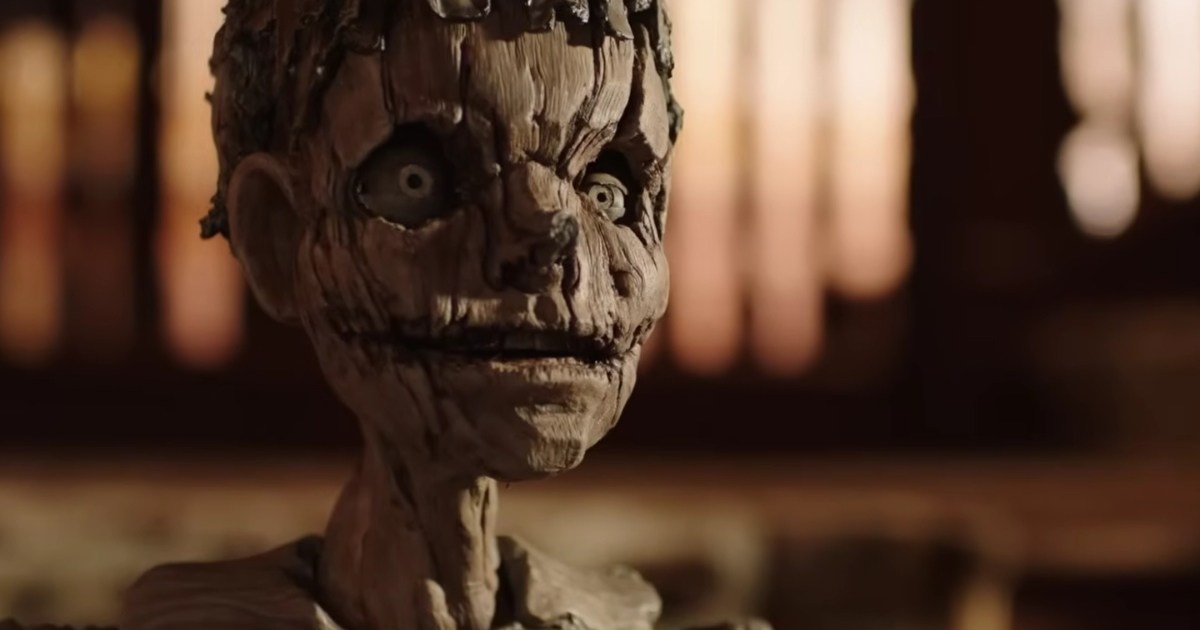
“A chilling reimagining of the familiar fable, Pinocchio Unstrung unfolds inside an elite London prep school. Influenced by a sinister Cricket (Robert Englund) and created by Geppetto (Richard Brake), Pinocchio launches a violent crusade to carve himself into a real boy like his brother James, one piece at a time,” says the official synopsis.
Tyler Treese: Rhys, congrats on Pinocchio Unstrung. The first Blood and Honey was very bare-bones. You didn’t have much of a budget. Now, since you guys keep reinvesting what you make from these movies, you’ve been able to grow as a director and put out better products each time. How has it been undergoing this very public development? Usually, we don’t see a no-budget film seen by this many people. It’s been interesting to see that progression.
Rhys Frake-Waterfield: Normally, when people are in the early stages of their filmmaking careers, and they’re in university or learning the game, they make short films that the world never sees. You always hear filmmakers say, “I’m never showing you my short film.”
My short film is basically Blood and Honey 1, which the world saw, and it went absolutely global. That was very early in my career. I was still getting to grips with understanding the language of cinema and filmmaking.
Even though there were budget restrictions, I’m hoping people see my latest film and see a big improvement compared to the other ones because I feel like I’ve developed a lot since then.
I’ve got very thick skin, so I didn’t really care about all of the negativity and hate. I was brushing it off and laughing about it because you’ve just got to keep getting better and better and keep at the grind to eventually achieve what you want to achieve as a filmmaker. I feel like with each version, I’m becoming a better and better filmmaker.
This film has some really wicked kills. There’s one in a gym where it’s almost like Final Destination, with all the gym equipment going wrong. Talk to me about how you approached a kill like that and what your inspirations were.
That was quite early in the film. I think that’s around 20 or 25 minutes. There is a bit of a rule we try to adhere to when we’re making a film that something fun needs to happen every 10 minutes, normally some sort of death scene or something like that.
In Pinocchio, that’s why there’s that death scene, which is more of an accidental moment. His natural presence as a wooden puppet causes a chain reaction like that. It made sense to me to have an accidental death in the film before he goes on his actual journey and starts trying to become a real boy.
I’ve always thought about what it would be like to either slip on a treadmill or be squatting a heavy amount of weight in the gym and then slip. It’s always gone through my head whenever I’ve done both of those exercises. I don’t think I’ve seen them in any film, so I thought, “Okay, I’ll have a go at it and see how it turns out.”
They were hard, and it almost didn’t work. In the early stages, I was thinking, “How am I going to pull off the fall on the treadmill?” I got a stunt performer in there, and she was running on the treadmill. She slipped and fell down, but when you’re on a wide shot, it doesn’t really sell the impact you imagine in your head.
In my head, I was imagining her head smacking on the treadmill and her neck breaking. I thought, “I can’t ask a stunt person to do that. She can’t break her neck for me.” So I was thinking, “What do I do?”
Funnily enough, nearer the end of the film, you can see Pinocchio create this human-like puppet character. We used that on set and dressed it up in the performer’s clothes. I just threw it onto the treadmill, and it worked really well.
That human puppet creation was able to break its neck and go absolutely flying. I was able to send it off at maximum speed. That worked.
For the gym squat moment, we had a practical back built for the stunt guy. When he bent forward, it looked like his spine snapped out. I thought that was really fun, and I hope it makes people squirm a little bit.
Tyler Treese: At the end of the film, once the credits start rolling, we get to see some behind-the-scenes footage. We get to see the Pinocchio puppet. How important was it to have practical effects at the core of Pinocchio Unstrung?
Rhys Frake-Waterfield: It was really important. That was one of my early decisions. I thought, “No, I want to go down a practical route with this.”
The whole story of Pinocchio is fundamentally about craftsmanship and Pinocchio physically being made in the story, so I thought I wanted to physically make him as well. I decided to fully embrace that and make that a motif throughout the film.
Right from the start, you can see the use of shadow puppets, all practical. You can see a practical title card. The doll is practical. The gore is practical. For the end credits, I shot them on a projector, with Pinocchio’s hands pulling them off.
Then you can see some of the behind-the-scenes footage afterward to show how bloody hard it was to work with a puppet.
It was super important to me because I’m a massive horror fan. I love the use of practical effects, and I think any horror fan does as well. You can tell when something has gone down a digital route. Even though it’s way easier to shoot, it doesn’t give you the kooky, crafty vibe and atmosphere that I really wanted for the film.
Your producing partner, Scott Chambers, is taking over Blood and Honey for the third film. Was it weird giving up that title, or was it refreshing to be able to do new things like Pinocchio?
There’s a bit of both. I’d been in the Blood and Honey world for a long time. There was the first one and the second film. I was also in the background producing and helping with the Bambi and Peter Pan films.
We had the option of doing Blood and Honey 3. It was greenlit and ready to go, but there was also Pinocchio. I didn’t want to do both films and stretch myself too thin because then I thought neither of them would be good.
I decided to hand the reins over to Scott to have a go at the Blood and Honey 3 universe. But it was strange because these characters, which I’d been thinking about for years and years, were then handed over to someone else.
At points, you want to jump in and say, “No, do it like this,” but then you have to remember, “I’m not the director on this one,” so you have to step back.
It was also super refreshing to tackle a different universe and a different character. You’re not constrained. When I was writing Pinocchio, I wasn’t constrained by prior elements I’d built, characters, world-building, and trying to create a story within those constraints. Everything was free.
I could do whatever I wanted with the story. That was really creatively freeing. Early on, I could have taken Pinocchio down a really sinister Annabelle route, or I could have gone down a campier, more fun route, which is what I decided to do.
This is all building to Poohniverse: Monsters Assemble, which is an incredible title. Do we have any update on when you’re looking to film that one?
Rhys Frake-Waterfield: That’s the next one we’re filming. We’re writing the script now and preparing. That takes a little bit longer than the other films because there’s so much involved.
You can imagine it’s not just the Blood and Honey characters. I want to bring everyone into it. I want to bring in the Peter Pan character. I want to bring Pinocchio back into that world as the doll. I want to bring Bambi into it.
This big ensemble crossover is a bit of a mountain to climb as we figure out the right story to tell and show how they’re all interconnected.
That’s my next one. We’re probably looking to shoot it in early 2027.
Generally, what are you aiming for output-wise with the TCU? It seems like two a year is a good balance when it’s not a bigger one like Poohniverse.
We’re looking at about two a year. I think we’ve probably averaged about one and a half because Pinocchio took me way longer than I was hoping.
Even once I finished it, I was stuck in post-production for so long because I had to do so many of the string-removal shots. I did about 200 of them myself to try to get rid of the strings because we were moving him around, and there were all these hands and strings you had to remove.
On average, we’re looking at about two a year unless it’s something bigger, and Poohniverse is a bigger one. Once that’s done, we’ll reassess things because then we’ll be looking to move toward more of a Phase Two approach, a bit like Marvel.
Thanks to Rhyse Frake-Waterfield for taking the time to talk about Pinocchio Unstrung.